
In 2022 the market declined -20%1 then bounced back in 2023 +26.29%. This year, the S&P 500 gained 7.63%. So, everything is good? We say no so fast. Let’s start with why the market declined.
In March 2022, the Federal Reserve Bank increased interest rates from nearly 0% to 5% over the next year and a half. Why did the ‘Feds’ raise interest rates so aggressively? One word: inflation. We dumped $6.2 trillion into the US economy in 2020 and 2021. This stimulus to fight the effects of the Covid lockdowns and other efforts needed to be countered. The media told us that supply chain interruptions and other COVID-related problems were at fault. Any economics student, as Professor Rex Pjesky stated on our radio show,2 can tell you that “too much money chasing too few goods” is a major cause of inflation. How does this happen?
It is always the Government or the Federal Reserve that causes the situation of too much money. The Federal Reserve needed to pull this money back. That is done through higher interest rates. One measure of the US money supply is M2.
Money Supply or M1 is the metric used for the total amount of money that the American public holds in coins and paper currency, easily accessible checking and savings accounts, and other accounts that can quickly be converted to cash. M2 includes all the money in M1 plus funds held in short-term time deposits like money market funds and certificates of deposit (CDs).
M2 began increasing in March 2020 and peaked in July 2022. It was an increase of $5.725 trillion. M2 dropped since the Feds increased interest rates. In July of 2022, $21.713 trillion. By April of 2023, it had dropped $1.031 trillion.
“Is this bad,” you ask? To quote S&P 500 Market Intelligence, “Declines in M2, as the US is seeing now, have been correlated with economic depressions and panics.”
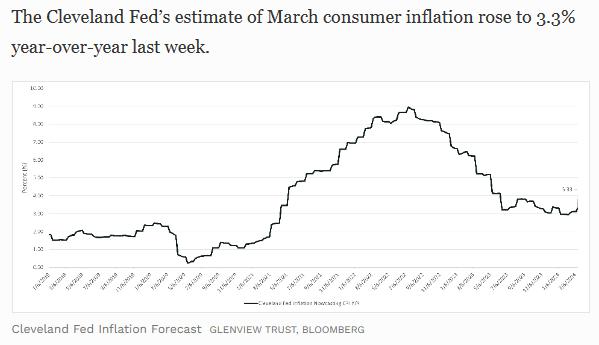
It is very dicey if M2 means anything. We have enormously manipulated the financial system with large cash infusions with inflation being the natural side effect. Recently, the inflation numbers came out showing a possible increase.
“Consumer inflation (CPI) came in higher-than-expected last week at a 3.2% year-over-year pace. Perhaps more importantly, services inflation remains elevated and sticky. The supercore measure of services inflation, which removes the distortion from the overstated government measure of rent inflation, held steady at 4.3% year-over-year”4
If inflation isn’t receding, then the Fed can’t cut rates. The Federal Reserve is targeting a 2% inflation target. The market is giving a 60% chance of a rate cut in June. This is down from the 100% rate cut expectation. It is too soon to know if inflation is going higher. But the markets are expecting a cut; no rate cuts mean increased volatility for stocks.
Headlines
In the past, when there was a recession, it was amazing
– it flipped like a light switch. -Elon Musk
As we continue to negotiate a market that seems unstoppable, we must realize that not everyone is convinced that our economy is in good shape. The AI revolution is fueling the current uptrend. What is happening in the economy and how the stock market reacts is disconnected. For long-term investors who are pre-retirees and retired, caution is recommended. A significant market decline will affect your retirement for years. Remember that your account balance is not yours until you sell it, protect it, or cause it to cash flow income.
The following headlines are between January – March 2024
⦁ Stocks are pricey, and Warren Buffett wants no part of the “casino.”
⦁ Fed’s Aggressive Rate Hikes Will Soon Be Felt With Significant Repercussions
⦁ The Magnificent 75 Are More Overvalued Than You Think
⦁ The stock market is looking a lot like it did before the dot-com and ’08 crashes, a top economist says.
⦁ Macro Risks Rise As S&P 500 Momentum Eases
⦁ Your Juicy Cash Yield Could Disappear quickly.
⦁ U.S. Money Supply Is Shrinking the Most Since the Great Depression. Is an Economic and Stock Market Meltdown on the Way?
⦁ Inflation Readings Complicate Rate Cut Timing For Markets.
⦁ US bankruptcies surged 18% in 2023 and are seen rising again in 2024.
⦁ BowFlex files for Chapter 11 bankruptcy protection.
⦁ US Corporate bankruptcies hit 13-year peak in 2023
⦁ Wall Street titans like Jamie Dimon, David Solomon, and Jeffrey Gundlach
are still worried about a recession — and warn investors are too complacent.
“With each passing day, this has the feel of being a cross between 1999 and 2007.
It is a gigantic speculative price bubble across most risk assets, and while AI is real, so was the Internet, and so were the high-flying stocks that populated the Nifty Fifty era,” he said, referring to the group of 50 large-cap stocks that dominated the stock market in the 60s and 70s, before falling by around 60%. – David Rosenberg Economist, Markets Insider Jennifer Sor.
How to buy Bonds.
We are adding a bond and stock manager to our managed portfolio. The manager replaces the exchange-traded funds we use using individual positions primarily. We are looking at fixed-income positions like individual bonds, preferred stocks, and other income positions. We will be calling to explain the changes. Charles Schwab requires an additional form so we can start this management on your account. Not all of our clients are well suited/suitable to this program. Call us to see if and how this would work for your situation.
On the Radio
We are now doing interviews at local restaurants in Amarillo. Listen in to see who we review next. Our first restaurant was Bangkok Tokyo’s



Sources Citations Bibliography:
1. As measured by the S&P 500 2022 price return was -19.64% and -18.11% when including dividend reinvestment. 2023 saw a total return of 26.29%.
2. The Toro Bravo Retirement Income Show airs on NewsTalk AM940 Amarillo. Saturday and Sunday at 10 am.
3. Sources include S&P Global Market Intelligence “US money supply falls at unprecedented rate, possibly cooling inflation” and Motley Fool “M2 money supply contractions, which have led to economic turmoil in the past. But perhaps this time will be different.”
4. Quote from Forbes: Inflation Readings Complicate Rate Cut Timing For Markets.
5. In 2023, Bank of America analyst Michael Hartnett began using the phrase “Magnificent Seven,” which includes Microsoft, Amazon, Meta (Facebook), Apple, Nvidia, Telsa, and Alphabet.
6. Who is David Rosenberg? Prior to Rosenberg Research, David was Chief Economist & Strategist at Gluskin Sheff + Associates Inc. from 2009 to 2019. From 2002 to 2009, he was Chief North American Economist at Merrill Lynch in New York, during which he was consistently ranked in the Institutional Investor All-Star analyst rankings. Prior to it, he was Chief Economist and Strategist for Merrill Lynch Canada, based out of Toronto, where he and his team placed first in the Brendan Wood survey of Canadian economists for ten years in a row.
Supplemental Disclaimers:
This article is informational only and is not investment advice. This is not an offer to buy, hold, or sell investments like securities or insurance products.
Securities and Investment Advisory Services are offered though Toro Bravo Investment Advisors, LLC. Life Insurance and Annuities sold as an insurance broker are not a fiduciary relationship and are not offered by Toro Bravo Investment Advisors, LLC.
Securities or Insurance are not FDIC/SIPC insured and investments contain risk plus could be subject to loss. Losses could be short term or permanent.
Economic and market information has been obtained from published sources. While we believe such sources to be reliable, TBIA does not assume responsibility for the accuracy of such information. Numbers and figures illustrated are hypothetical in nature and past performance is not a guarantee or indication of future results/performance.
We are not affiliated with the Social Security Administration (SSA), Internal Revenue Service (IRS), or any Governmental Agency.
Do not rely solely on the Legal, Tax, or Financial information presented for it may not be suitable for your individual situation.
Consult your legal, tax, and/or financial professional before acting on any strategy or recommendation (i.e. major changes or before initiating the purchase, hold, or sale of any investment or investment strategy). Every individual’s strategy can differ depending on current circumstances and goals.