
“Over the last 40 years, 71% of the market returns came from dividends, not capital appreciation. So, rule one for me is I’ll never own stuff that doesn’t pay a dividend, Ever.” -Kevin O’Leary (Shark Tank) Forbes interview
I know I used that quote in last month’s newsletter but we wanted to follow through on the importance to dividend investing when investing in stocks for retirees and pre-retirees.
Here are some reasons retiree and pre-retiree investors should avoid growth1 investments. Growth investing assumes the future price of the stock will be higher and that you have a buy and hold strategy. If there is a drop in the price of the stock your ability to wait 3, 5, or even 10 years will ultimately payoff. If you are going into retirement or currently retired, do you really have that kind of time? Notice the chart below:
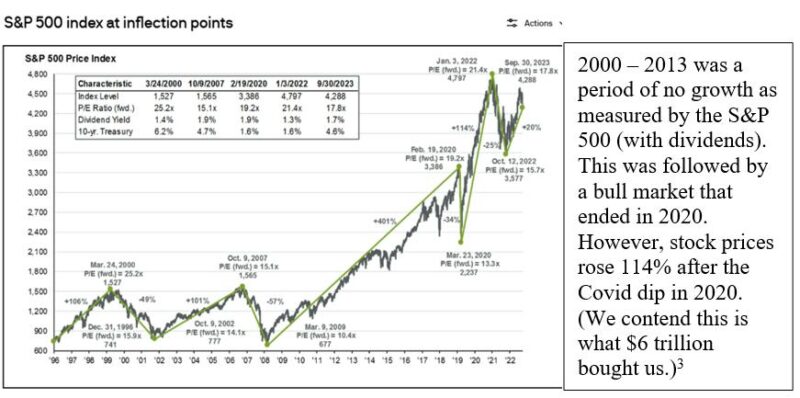
If you are a pre-retiree you need perfect timing to move into income investments before a 30 -50% decline in your accounts. That is crystal ball level insight. Down markets have changed more retirement plan dates than anything else.
If you are retired you are depending on selling your shares for income. If you make these withdraws (selling shares) at lower prices you will see erosion of your retirement savings. This causes hard lifestyle choices for elderly retirees. Selling shares is the opposite of the hold in buy and hold!
A dividend portfolio provides cash flow that doesn’t require you to sell your shares at market lows4. Now you can hold through market lows.
We contend that shifting to dividend portfolio for money invested in the stock market reduces risk even if you do not need the income yet. Notice what the investment research site called Investopedia states:
“Dividends are a major factor in reducing overall portfolio risk and volatility. In terms of reducing risk, dividend payments mitigate losses that occur from a decline in stock price. But the risk reduction benefit of dividends goes beyond that basic fact. Studies have historically shown that dividend-paying stocks outperform non-dividend-paying stocks during bear market periods. While an overall down market generally drag down stocks across the board, dividend-paying stocks usually suffer significantly less decline in value than non-dividend-paying stocks.5”
This discussion revolves around the stock market. Most retirees look at other investments (we call contracts) for their retirement that reduces risk. Examples are Certificates of Deposit, Bonds and Annuities. These investments have disadvantages and nuance that need to be tailored to your specific liquidity, risk tolerance, time horizon and income need.
As we always say call to review your situation. If the market is trending into the feared ‘Bear’6 then now is the time to review your strategy and investments.
Radio Show Update

The Toro Bravo Retirement Income show on NewsTalk AM 940 is moving to 10am on Saturday and Sunday.
Be sure to tune in for the compelling interviews and great content! We are also doing $100 gift card giveaways in November. So be sure to listen in at our new time.
The Heirs, the Retirement and the Tax Witch
November 14, 2023
Come join us for dinner at X- Steakhouse for a riveting discussion on
“How to protect your wealth from creditors, predators and taxes.”
• It’s about the taxes now and in the future!
• Estate taxes are going back to “historical norms,” what does this mean for you?
• See how the ‘super wealthy’ avoid estate taxes and build an intergenerational wealth and how you can do the same.
• How probate works, and the best ways to help avoid it.
• Which types of powers of attorney are best, and which ones could leave you powerless if you become disabled.
• Important strategies to pass assets tax free to your family.
• The advantages and disadvantages of the different types of Wills and Living Trusts.
• There are other options to buying long term care insurance.
• Why putting property in the name of your children could be a mistake + much more!


Sources Citations Bibliography:
1. Growth investors look for profits through capital appreciation—that is, the gains they’ll achieve when they sell their stock (as opposed to dividends they receive while they own it). In fact, most growth-stock companies reinvest their earnings back into the business rather than paying a dividend to their shareholders. -Investopedia.com
2. The chart on this page is from Guide to the Markets Fact Set, Standard and Poors, JP Morgan – U.S. Data are as of 09-30-2023.
3. The $6 trillion we are referring to is the amount of money the US government poured into the economy for Covid relief.
4. Stock dividends are not guaranteed and can be cut by the company. The stock price can also fluctuate quite drastically if the company has financial difficulty.
5. Direct quote from “5 Reasons Why Dividends Matter to Investors Updated January 31, 2022 – Investopedia.com
6. Bear markets are defined as sustained periods of downward trending stock prices, … Bear markets are often accompanied by an economic recession and high unemployment, -Investopedia.com
Supplemental Disclaimers:
This article is informational only and is not investment advice. This is not an offer to buy, hold, or sell investments like securities or insurance products.
Securities and Investment Advisory Services are offered though Toro Bravo Investment Advisors, LLC. Life Insurance and Annuities sold as an insurance broker are not a fiduciary relationship and are not offered by Toro Bravo Investment Advisors, LLC.
Securities or Insurance are not FDIC/SIPC insured and investments contain risk plus could be subject to loss.
Losses could be short term or permanent. Numbers and figures illustrated are hypothetical in nature and past performance is not a guarantee or indication of future results/performance.
We are not affiliated with the Social Security Administration (SSA), Internal Revenue Service (IRS), or any Governmental Agency.
Do not rely solely on the Legal, Tax, or Financial information presented for it may not be suitable for your individual situation.
Consult your legal, tax, and/or financial professional before acting on any strategy or recommendation (i.e. major changes or before initiating the purchase, hold, or sale of any investment or investment strategy). Every individual’s strategy can differ depending on current circumstances and goals.